 Multichain
 anyCall cross-chain messages and contract execution
Multichain anyCall carried messages between blockchains so receiving applications could execute instructions through destination contracts. The protocol relied on Multichain's secure multi-party computation (SMPC) network. Its historical V6 and V7 integrations defined how applications sent instructions, paid execution fees and handled failed calls. Multichain's team ceased operations during the July 2023 crisis.
A message's destination contract determined the action its payload triggered. Understanding an old integration required its version and receiver permissions. A source transaction showed one part of the operation; the receiving application's outcome established whether the requested work finished.
Payloads carried instructions the receiver had to implement
An anyCall request identified a receiving contract, encoded data and a destination chain ID, giving the receiving application the information it needed to perform its own operation. The sender supplied bytes; the receiver interpreted those bytes through its
anyExecute
handler. Application code connected the payload to a concrete action. The V6 burn-and-mint token-bridge template needed minting logic and token permissions, while a reward integration needed its own distribution rules. Generic messaging supplied neither permission to mint an arbitrary token nor a universal definition of application success.
The Router handled asset delivery. anyCall supplied contract messaging, which applications could combine with asset operations through compatible integrations.
V7 peers, executor permissions and message context
V7 integration required a sender contract on the originating network and a receiver exposing
anyExecute
on the destination network, with both sides using the intended deployment. The receiver's access control needed to authorize
AnyCallExecutor
, the component making the final application call. Authorizing the sender's wallet instead would not match that call path.
An application needed to match the remote sender and originating chain in the request context to its configured peer, alongside the local executor check, because the messaging infrastructure served more than one application. A call arriving through the authorized executor could still carry instructions from an unintended remote contract if the receiver omitted its peer checks. Payload decoding also needed to match the sender's encoding.
Did the V7 text message reach the receiving contract?
A matching
NewMsg
event from the destination receiver established text receipt in the historical V7 demonstration, provided it contained the expected decoded message and its transaction's LogAnyExec identified the source request.
The demonstration encoded a string on the source side and decoded it inside the receiver's
anyExecute
function. Its receiver emitted
NewMsg
and returned success. Destination dispatch and receiver handling could occur inside the same destination transaction.
| Stage | Component | Work performed | Outcome or dependency |
|---|---|---|---|
| Request emission | Source sender and anyCall | Submitted encoded text and emitted LogAnyCall | Recorded a cross-chain request |
| Relay | SMPC network | Observed and relayed the request | Required functioning relay infrastructure |
| Destination dispatch | anyExec and AnyCallExecutor | Invoked the selected receiver | Reached the configured execution path |
| Application handling | Receiver's anyExecute | Decoded text and emitted NewMsg | Text receipt in the matching anyExec transaction |
When reconciling the demonstration's records, the expected outcome was the message in the destination receiver's event log. Compare the emitting contract and network with that expectation. A source-side
NewMsg
event alone established no destination receipt. A destination event with the expected text demonstrated anyCall delivery when its transaction's LogAnyExec matched the source request. It did not establish token minting or reward distribution.
Fee flags changed between V6 and V7
V7 flags selected source or destination payment and independently allowed fallback, so the same destination call could use different funding arrangements without changing the receiver's application purpose.
In V7, flag 2 selected destination-paid execution fees. Flag 0 selected source payment without fallback. Flags 4 and 6 enabled fallback with source and destination payment respectively. These values described the V7 interface; V6 used flag 2 for source payment.
For source payment,
calcSrcFees
combined the application and destination fee settings with the payload length, calculating a base charge plus a per-byte charge whose inputs depended on the configured fee mode. Custom-fee mode selected custom values; otherwise the implementation selected the larger custom or default value for each component. The quoted amount therefore depended on configuration and encoded data size.
Destination payment used native-currency credit held in V7's configuration contract for the destination application. Underfunding could block execution. V6 instead associated destination fee credit with the source application's address, so copying an old deposit setup could credit the wrong account.
Failed execution, fallback and stored retry records
When a V7
anyExec
transaction completed with application failure, enabled fallback requested a return message. Without fallback, the implementation stored a retry record.
Fallback called
anyFallback
on the originating application with the original payload. Its behavior depended on that application's implementation. A fallback request did not itself prove a compensating action had executed, and the messaging mechanism did not define a universal refund.
The published V7 implementation also provided
retryExec
for stored failures. A retry needed the stored record matching the original request, receiver and payload. The administrator could restrict retries through
retryWithPermit
.
Application recovery still required executable receiver logic. Funding a budget or finding a stored record could not repair an incompatible payload or restore unavailable relay infrastructure.
Could a V7 receiver send another cross-chain message?
V7 allowed an application's
anyExecute
handler to initiate another
anyCall
.
That supported continued interactions, including forwarding a message to another chain or sending execution information back to the originating application. The receiving application had to implement that continuation; the protocol did not make every message a request-and-response exchange.
Each additional call retained its own destination and execution requirements. Success in the first receiver could therefore coexist with an unfinished later call. A chained design needed to distinguish its local handler outcome from completion of the further action it requested.
Reward messages, token minting and NFT gateways
Curve's cross-chain gauge integration used anyCall for reward-related coordination, illustrating how destination instructions could support an application without making the message itself a token transfer.
The historical V6 permissionless token-bridge template coupled source-chain burning with destination-chain minting through an anyCall message. It required compatible tokens, minting and burning permissions and configured token and client peers. Those prerequisites belonged to that bridge implementation. The message alone could not grant minting authority to a receiver.
NFT gateway templates supported ERC-721 and ERC-1155 integrations. Their documented lock-and-mint design locked a source NFT and minted a corresponding destination NFT with the same token ID. The gateways and token contracts implemented those NFT-specific actions. The destination handler needed authority to perform the requested NFT operation.
The historical USDC Cross-Chain Transfer Protocol (CCTP) integration also used anyCall to coordinate attestation retrieval and destination minting after a source burn. Circle's signed attestation supplied mint authorization. That integration's asset-transfer rules remained separate from generic anyCall messaging.
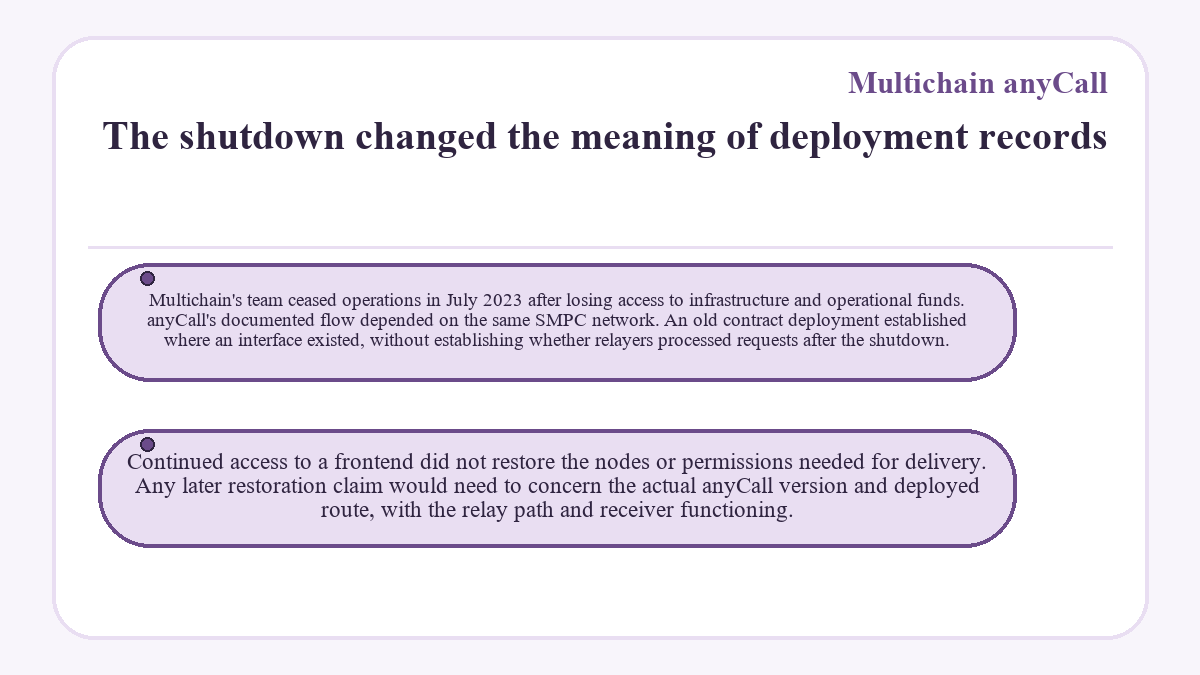
The shutdown changed the meaning of deployment records
Multichain's team ceased operations in July 2023 after losing access to infrastructure and operational funds. anyCall's documented flow depended on the same SMPC network. An old contract deployment established where an interface existed, without establishing whether relayers processed requests after the shutdown.
Continued access to a frontend did not restore the nodes or permissions needed for delivery. Any later restoration claim would need to concern the actual anyCall version and deployed route, with the relay path and receiver functioning.
Multichain anyCall: what people ask
Did generic anyCall V7 deployment require Router V7 whitelisting?
anyCall V7 offered a permissionless integration path, while Router V7's combined mainnet transfer-and-call integration required whitelisting. The V7 configuration code also supported a permissioned mode. These rules belonged to their respective integrations and configurations. A Router requirement therefore could not establish a universal admission rule for every anyCall deployment.
Which networks appeared in the historical V7 deployment list?
The historical anyCall V7 mainnet list named Ethereum, Optimism, BNB Chain, Fantom, Polygon, Arbitrum and Avalanche. That list described the V7 deployments, rather than every network Multichain ever supported. It also did not establish continuing delivery after the team's shutdown. V6 had its own deployment list, so the versions did not share an interchangeable compatibility statement.
Why did a V7 source-fee payer need to accept native currency?
V7 returned excess source-fee payment to the contract calling anyCall. Its implementation attempted that refund when the supplied value exceeded the calculated fee and required the transfer to succeed. A calling contract unable to receive native currency could therefore make an overpaid request revert. This requirement concerned source-fee refunds, not automatic compensation for destination failure.
Was the anyCall payload private?
Ordinary anyCall payloads did not provide confidentiality. V7's LogAnyCall event included the message bytes alongside destination and request details. Encoding application data into bytes did not encrypt it. A message containing sensitive information could therefore expose that information through its on-chain record, even when only an authorized receiver could execute the associated application action.
Could V7's string recipient parameter establish non-EVM compatibility?
A string recipient parameter alone did not establish a working non-EVM integration. The V7 interface included a string-address overload, which its implementation notes reserved for non-EVM support. That input format did not prove a deployed destination, compatible receiver or functioning relay path. Historical network coverage remained a separate question from the types the interface accepted.
Did V7's execCompleted field prove the receiving application succeeded?
V7's execCompleted field could be true even when the receiver reported failure. In a completed anyExec transaction, the implementation set that field after the execution attempt regardless of the application's success value. LogAnyExec carried a separate success value and result data. The field therefore recorded processing, while application success required its own evidence.
How could administrators change an anyCall V7 deployment?
The published V7 architecture included upgradeable executor and messaging proxies, plus a replaceable configuration contract. The implementation also exposed controls for pausing and changing associated contracts, subject to administrator or MPC permissions. A persistent contract address therefore did not imply permanently fixed behavior; implementation changes and configuration changes could affect the integration behind that address.
Were anyCall messages secured by zkRouter proofs?
The anyCall implementation Multichain described in February 2023 used its MPC network. zkRouter was a separate zero-knowledge-proof development then presented with a testnet and proposed applications. Those plans did not establish migration of existing anyCall deployments to zero-knowledge verification. Applying zkRouter's proposed security properties to those MPC message calls would describe a different mechanism.